

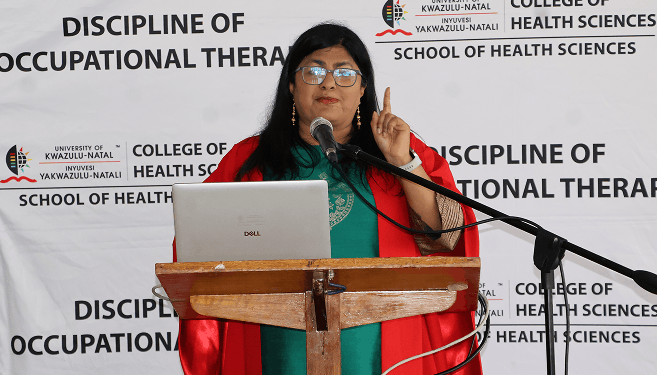
Professor Deshini Naidoo, Academic Leader of the Discipline of Occupational Therapy at the University of KwaZulu-Natal (UKZN), delivered her inaugural lecture on strengthening occupational therapy education, advancing equitable healthcare and preparing graduates to serve communities across South Africa. Her address reflected on more than two decades of scholarship.
Titled: ‘From Classroom to Community: Occupational Therapy Practice and Education for a Changing South Africa’, the lecture formed part of UKZN’s inaugural lecture series, which recognises academics’ promotion to full professorship and showcases their contributions to teaching, research and public scholarship.
Welcoming guests, Professor Busisiwe Ncama, Deputy Vice-Chancellor and Head of the College of Health Sciences, described inaugural lectures as milestones recognising academic excellence. They also give professors an opportunity to share their work with colleagues, students, collaborators and the public.
Introducing Naidoo, Professor Percy Mashige, Dean and Head of the School of Health Sciences, reflected on her career since graduating with a Bachelor of Occupational Therapy degree in 1998. She became Head of Discipline in 2026. He highlighted her research, leadership within the Health Professions Council of South Africa and contributions to occupational therapy practice nationally and internationally.
Naidoo structured her address around three ‘rest stops’: clinical practice and education, research and inquiry, and mentorship.
“I am a product of the university that I now teach in,” she said, reflecting on her pride as both a UKZN graduate and academic.
Drawing on her experiences in public healthcare, private practice, mental health services, rehabilitation and clinical work in New Zealand, Naidoo explained how frontline practice shaped her understanding of healthcare inequities and prompted her move into academia.
Naidoo argued that occupational therapy education must respond to the realities of South Africa’s health system. Her research has explored primary healthcare competencies, vocational rehabilitation, disability rights, community-based rehabilitation, occupational justice and graduates’ preparedness to work in under-resourced communities.
She emphasised that healthcare must address patients’ living conditions alongside treatment. “It’s no good giving people HIV medication if they don’t have food and they don’t have water to take the tablets with,” she said.
Her work has informed curriculum development at UKZN and contributed to the revision of national minimum standards for occupational therapy training through evidence generated across all nine South African provinces – replacing reliance on international frameworks with locally grounded research.
Naidoo argued that occupational therapy must evolve alongside changing healthcare needs. She identified digital health, artificial intelligence, tele-rehabilitation, climate-responsive healthcare, African-centred scholarship, and interprofessional education as critical priorities for the profession’s future.
She encouraged educators to embrace innovation while remaining firmly grounded in the country’s social context, noting that no single profession can address South Africa’s healthcare challenges alone.
Naidoo concluded by describing mentorship as the most important contribution she hopes to leave behind. She reflected on the challenges faced by early-career academics and stressed the responsibility of senior scholars to guide, support, and create opportunities for the next generation of researchers and health professionals.
She acknowledged the unwavering support of her mentors, collaborators, students, colleagues, friends, and family, paying special tribute to her late mother and father, whom she credited as her earliest and greatest supporters.
Delivering the vote of thanks, Ncama praised Naidoo’s more than 20 years of scholarship and its contribution to occupational therapy practice, health professions education, decentralised clinical training, vocational rehabilitation, disability rights and equitable healthcare in South Africa.
Words: Lunga Memela
Photograph: Supplied